


Inside the Campaign: Turning Academic Jargon into Campus Culture
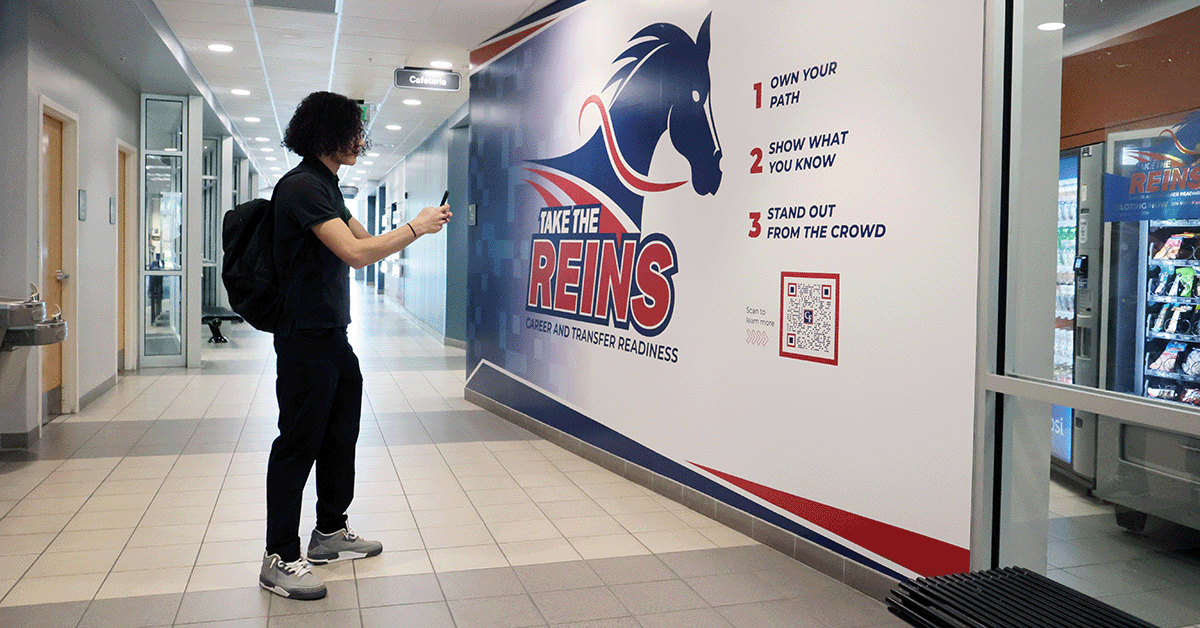
A college-wide communications campaign helped the College of Central Florida earn its first flawless accreditation evaluation in its nearly 70 year existence.
Before “Take the Reins” became an award-winning campaign, the College of Central Florida was wrestling with a familiar problem: an important initiative buried in academic language.
Danielle Veenstra, the college’s manager of digital communications, remembers confronting “a huge stack of papers filled with institutional jargon.”
After being at the college for one month, she struggled to understand what the plan was asking the institution to do.
“What does it mean?” she recalled asking.
That question became the starting point for a campaign that translated a complex accreditation document into something students and employees could understand and use.
The work ultimately earned the campaign the highest honor in the Florida Public Relations Association’s prestigious Golden Image Awards program.
Research: Letting the audience shape the work
The College of Central Florida was preparing for its 10-year reaccreditation through the Southern Association of Colleges and Schools Commission on Colleges. A central requirement was the college’s Quality Enhancement Plan, or QEP, focused on building student career and transfer readiness through micro-credentials.
Rachel Cote, APR, director of marketing, public and community relations for the college, said the team could have treated the work as another accreditation requirement. Instead, she called Veenstra and Sarah Eshleman, the college’s Graphic Design, Web and Public Relations Coordinator, into an early meeting with a different challenge.
“So that initial sort of meeting ended with me calling in Danielle and Sarah and saying, hey, ‘let's do something different, something better,’” Cote said.
That meant resisting the urge to jump straight into tactics. The team began with research, including focus groups with students and employees, polling and benchmarking.
That research quickly challenged some of their assumptions.
Cote said responses at the main Ocala campus differed from those at the more rural Citrus and Levy County campuses.
“And that was a light bulb moment … we can't just continue on doing what we originally planned,” she said. “We had to adjust based off of the research that we [were] getting to make sure that this truly is a good culture fit for the entire college, not just one campus.”
Feedback also revealed confusion between the early development of the QEP identity and the college’s athletics branding as well as the early fonts being used. The team revised the work to maintain a connection to the college while making the new initiative visually distinct.
Planning: Finding “Take the Reins”
The team still had to solve its original problem: how to distill a sprawling academic concept into something people could quickly understand.
The college’s mascot, the Patriot, depicts a rider on a horse – a seeming nod to Ocala’s heritage of being the “Horse Capital of the World”.
During brainstorming, that image helped unlock the idea.
“[We kept] looking at that and saying like, ‘oh, what is he doing?’ You know, ‘where is he going? He's taking the reins of his future, right?’” Veenstra said.
The concept fit both the college brand and the purpose of the QEP.
“We are the vehicle for students to get to where they need to go,” Veenstra added. “And what better than a horse? We already have the horse. It's part of our brand.”
The team focused on the horse rather than the Patriot figure to distinguish the campaign from athletics and simplified the messaging into three ideas: Own your path. Show what you know. Stand out from the crowd.
Implementation: Turning audiences into ambassadors
The communications challenge extended far beyond getting people to recognize a logo.
During the accreditation visit, evaluators could visit different locations, select random employees for interviews or approach students and ask what they knew about the QEP.
“So, that was the biggest fear – that we truly had to make sure that every single employee and every single student had at least a general awareness,” Cote said.
“Take the Reins” appeared across the campus environment through murals, elevator wraps, window clings, banners, posters, digital screens and other materials.
The team also recruited employees to serve as brand ambassadors.
“We wanted the people who were really excited about it and saw this for the truly good opportunity for students that it was. Like, this is a thing that is a big value to students if we can get them to see and participate in it,” Cote said.
Employees received talking points, training and resources. The campaign became part of the college’s annual convocation, and every employee received a “Take the Reins” polo.
In the week before the accreditation visit, town halls gave students and employees a chance to practice responding to questions. The team also gave them simple instructions when they did not know an answer: “Don't say you don't know. Say, ‘I don't have that answer, but I know someone who does,’” Veenstra said.
Evaluation: The moment of truth
When evaluators arrived, the communications team had to trust that the campaign had done its job.
Cote could see them scurrying around campus but was not present for many of the interviews.
“So, we were just holding our breath and hoping everything went well,” she said.
Veenstra was selected to participate in one of the sessions. Before speaking to evaluators, she wondered whether the preparation would hold.
“Did everyone remember their talking points? Do I remember my talking points?” she thought.
The results suggested it had.
Faculty and staff reported 92% positive sentiment and 88% program understanding, while students reported 95% positive sentiment and 90% understanding of the QEP.
Then came the most consequential result: the accreditation visit ended with zero findings, marking the first flawless QEP and reaffirmation evaluation in the College of Central Florida’s nearly 70-year history.
“So, it was just an amazing sort of relief when we got that e-mail from our college president,” Cote said.
For Cote, the experience reinforced why the first step in RPIE matters. The campaign moved on an aggressive timeline, and as the accreditation visit approached, the pace became increasingly hectic. Employees were juggling their regular responsibilities with last-minute campaign work, sometimes answering phones while stapling table tents that needed to go out that day.
“I think that's what happens with a lot of people is they have a truncated timeline. So, they drop off the research and go straight into implementation, but it really was such a valuable piece of the puzzle,” Cote said.
It also reinforced the role communicators play in translating expert language for the people who actually need to understand it.
“We had to really push back to say, ‘I see what you're saying here. I know it makes sense. I know it's accurate technically, but it's not going to resonate with people,” Cote added.
From needing a job to reaching the summit
For Veenstra, the Golden Image Awards brought her story full circle.
Seven years earlier, she attended her first local chapter professional development meeting for Florida Public Relations Association, while looking for a job and learned about the Golden Image Awards.
“Take the Reins” became the first entry she had submitted herself.
When the team received its Golden Image Award, Veenstra thought the night was over.
“I walked out and I go, ‘Rachel, you want a celebratory drink?’ So I was like, we're done. That's it.”
Then the final award was announced.
Named for Richard “Dick” Pope, founder of Florida’s Cypress Gardens and a friend of FPRA founder John W. Dillin, the Dick Pope All Florida Golden Image Award represents the highest honor presented through the FPRA’s Golden Image Awards program. For Veenstra, hearing “Take the Reins” called for that final recognition was completely unexpected.
“It was shock. I stood up, I started crying. I stopped crying because I was like, ‘I'm gonna get my picture taken.’ My bones were shaking. That's how much adrenaline was in my system,” Veenstra recalled.
Though the team knew it had produced strong work, the magnitude of the recognition was still sinking in.
“And I think that for the very first image entry I've ever submitted to get to the very top is mind-blowing, to say the least,” Veenstra said.
For more information about the Golden Image Awards, visit GoldenImageAwards.org.