


Inside the Campaign: More Than a Headline
How a road-safety campaign moved beyond statistics to tell the stories behind the loss
Rikki Grace, 25, and Megan Grace, 26, were walking along a sidewalk near downtown Melbourne in 2022 when a pickup truck left the roadway and struck them.
Rikki died that night; Megan the next day.
Nearly four years later, the crash still stands as a reminder of how quickly a life can be reduced to a brief online story, a few paragraphs in the newspaper and then forgotten.
The news reports told how Rikki and Megan died. What got lost was the question no one seemed to ask: Who were they before the crash?
Rikki was a third-grade teacher who volunteered with animal shelters, found joy in movement and stillness whether it was running 5Ks, meditating or getting lost in a good book. Megan was driven – having obtained her PhD in occupational therapy at age 25; was working three jobs and had just bought her first home.
Those were the details their families wanted people to know.
For Abby Hemenway, APR, Space Coast Transportation Planning Organization’s (SCTPO) public information and outreach manager, the “Crash Not Accident” campaign was about reclaiming the story from the circumstances of the crash.
“I think it's really important to remember who they were in life so that the impact lasts and that their story can be told the right way on the family's terms,” Hemenway said.
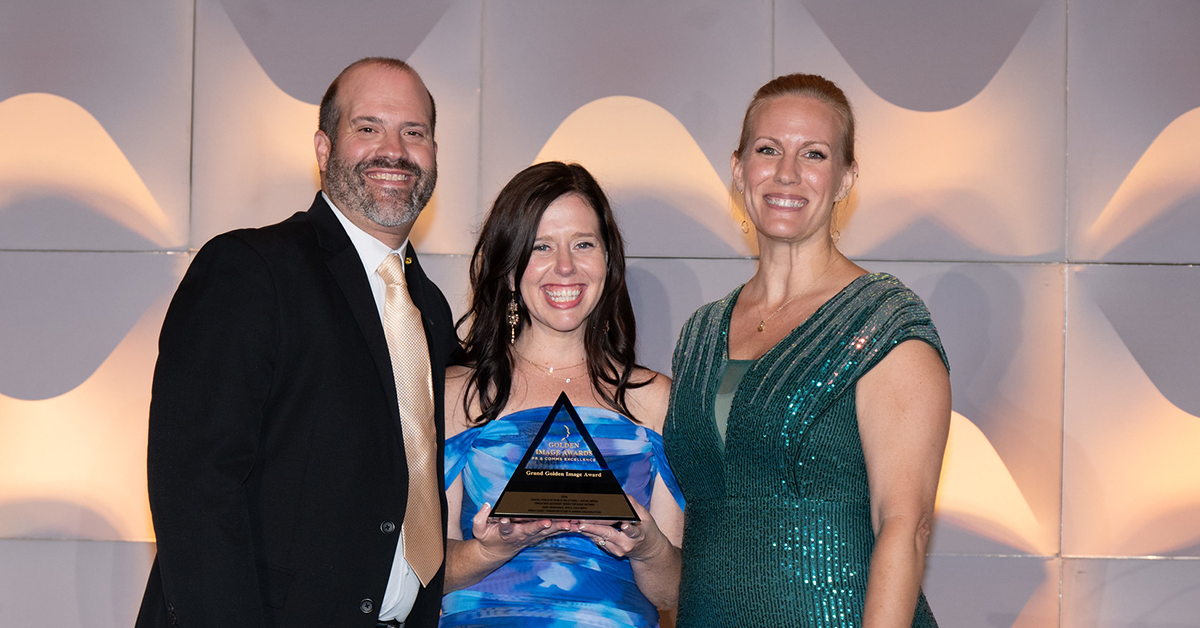
Those stories became a central part of a World Day of Remembrance social media campaign that would earn the SCTPO a Grand Golden Image Award, presented to the best Golden Image Award-winning entry in the Florida Public Relations Association’s Digital Tools of Public Relations division.
But the campaign began a year earlier with something far less celebratory: a communications effort that Hemenway knew had fallen short.
Research: When recycled stories stopped resonating
In 2024, the SCTPO lacked the staffing resources to cultivate new stories. Hemenway reused material from previous years, and engagement declined.
“It didn't resonatethe same way,” she said.
More importantly, Hemenway felt the previous effort had not done justice to the families for whom World Day of Remembrance carries enormous weight.
“This day for the families is a big deal, not just in our area, but nationally. And it brings them together in a way that's really beautiful,” she said.
By 2025, the SCTPO had hired a new community engagement coordinator, Leah Nepo, giving Hemenway additional support and someone with whom she could build a more deliberate strategy.
The team began by studying what other communities were doing. Hemenway looked at World Day of Remembrance efforts in larger cities such as New York and Boston and noticed how often they relied on physical and visual reminders of the people who had died, including shoes and other belongings left behind.
That research helped the SCTPO envision a layered campaign: social storytelling, a permanent online memorial and an in-person remembrance event with physical elements honoring victims.
The team also examined its own 2024 digital performance. Facebook emerged as the SCTPO’s strongest channel for community interaction and, critically, gave families an easy way to share their loved ones’ stories beyond the agency’s existing audience.
Planning: One story, everywhere
The strategy was simple but deeply human: replace passive traffic statistics with individual stories.
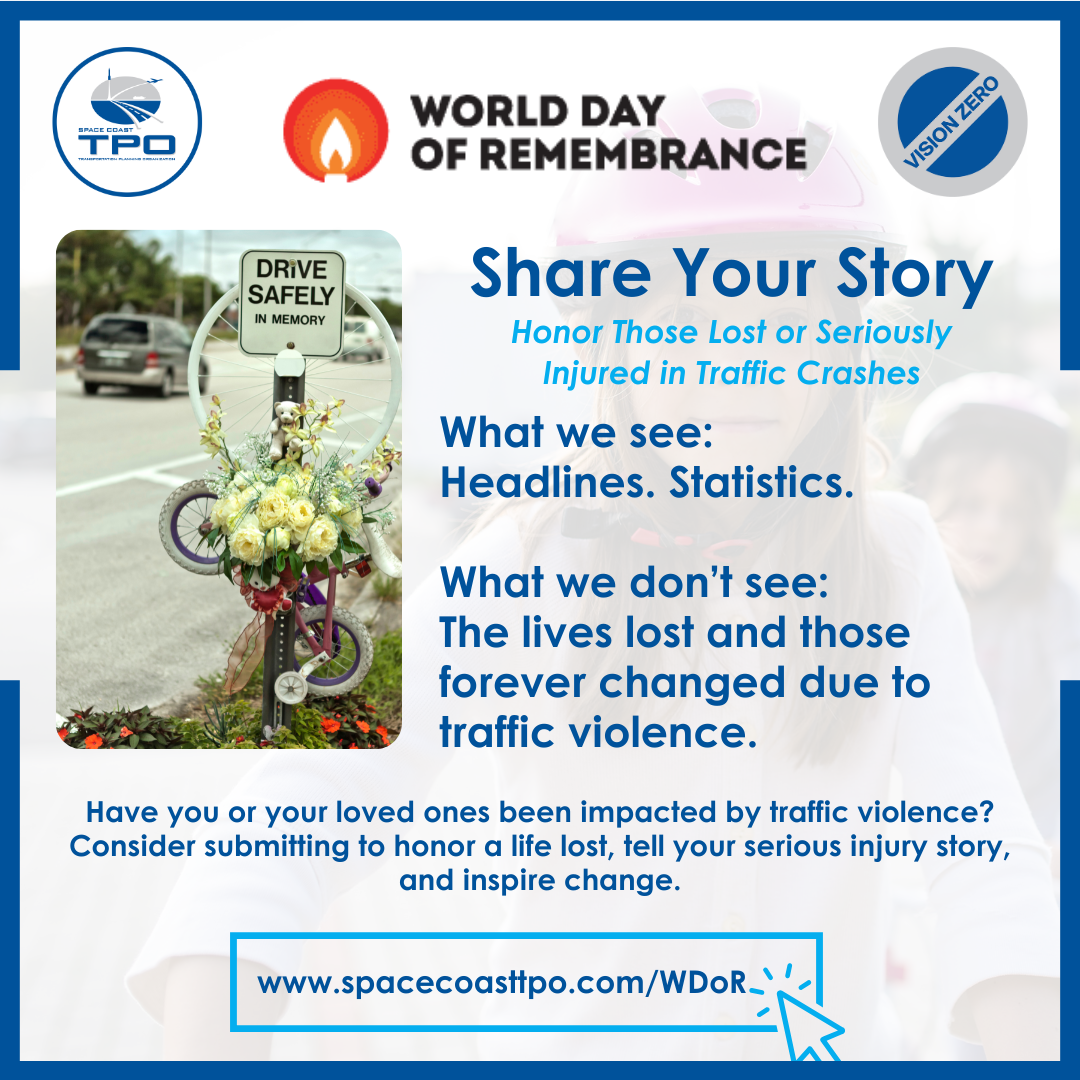
The SCTPO issued a call for submissions and contacted families participating in their annual World Day event. The team approached those conversations carefully.
“It's never easy,” Hemenway said. “We really try to approach it with a tenderness and a kindness and really lean into, ‘we want to tell their story and you're the best person to do it.’”
The emphasis was not on how someone died, but rather how they lived.
That distinction also informed the campaign’s name – identifying the tragedies of lives lost in a crash, not an accident. The SCTPO’s Vision Zero philosophy holds that roadway deaths are preventable, not an inevitable cost of mobility. The campaign sought to challenge a culture in which serious crashes can become background noise and victims are reduced to statistics.
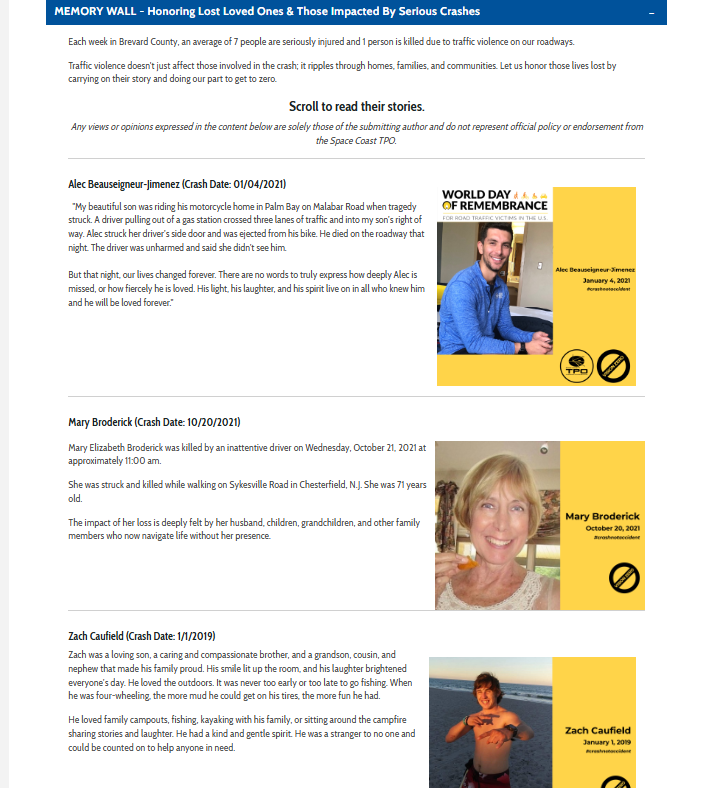
The team built the campaign around what Hemenway later as “one story distributed everywhere.” Each submission would become a social media spotlight, a story on the online Memory Wall and part of the broader World Day experience.
Implementation: Giving families the story back
The campaign produced 20 personalized Victim Spotlight graphics and launched a permanent “Crash Not Accident” Memory Wall on the SCTPO’s website. During campaign week, Nov. 12-18, 2025, the SCTPO staggered the stories on Facebook around the Nov. 16 World Day of Remembrance event.
But implementation included an important step that would become central to the results.
Once a victim spotlight was published, the SCTPO sent the family a direct link.
“They didn't have to go and do any digging. They didn't have to go and do any guesswork,” Hemenway said.
That made the families more than subjects of the campaign. It gave them an easy way to become its messengers. What Hemenway did not expect was what happened next.
“I expected them to be a champion for their loved one. I didn't expect it to become this network of support for each other,” she said.
Families began commenting on and reacting to one another’s stories. That was the moment the campaign became something different.
“Seeing them support one another was really, really beautiful,” she said. “And, you know, getting shares is amazing, getting those reactions. But for me, I'm like, wow, this is something unique here that we haven't done before. And we're not really leading it.”
A story Hemenway carries herself
There was another reason Hemenway understood the need to tell these stories as more than crash reports.
When she was 20 years old and in college, her father, Arthur, died in a traffic crash.
“My dad passed away in 2008,” she said. “I was 20 years old and I was in college and it was very, very unexpected.”
Years later, she found herself working in transportation safety, with the anniversary of her father’s death falling around World Day of Remembrance. Hemenway said the work has unexpectedly become part of her own process of understanding the loss.
“I actually think it's been healing for me in a huge way because I'm able to, you know, hug a stranger and be like, ‘I've been where you are. It's not going to feel like this forever.’”
She does not lead with her own experience when working with families, she said, because she does not assume their grief is the same as hers. But it has created what she described as an “innate responsibility” to stand with them.
That experience sharpened one of the central lessons she took from the campaign:
“Every story is worth telling,” she said.
Evaluation: Beyond likes and shares
The numbers told one story.
The campaign generated 36,188 Facebook views, more than triple its 10,000-view objective, with 75.6% coming from non-followers. It generated 1,274 reactions, 133 comments and 93 shares, along with 954 profile visits and 17 new followers. The Memory Wall received 246 unique visits, surpassing its goal of 150. The effort used no paid advertising.
In a campaign designed to humanize statistics, its most meaningful outcome may have been something no analytics report could fully measure: people connected by loss finding one another.
“I felt like our campaign hit home when I saw families of lost loved ones commenting and liking and loving other posts of lost loved ones,” Hemenway said. “These families start to know each other because they come to this annual event. They really sit with each other in this grief. It's an interesting bond to watch form because you really truly don't understand unless you've lived through it.”
Doing the families proud
Hemenway almost did not enter the campaign in the Golden Image Awards.
She was short on time and questioned whether the work had enough “meat” for an entry. Then a comment from a local elected official about transportation and traffic safety struck a nerve.
She decided to submit it.
“If anything else, we did it for the families. It wasn't for an award at all,” she said.
When the campaign ultimately received the Grand Golden Image Award, Hemenway said the recognition meant something different because of whose stories were behind it. Not only did it validate the strategy. More importantly to Hemenway, it substantiated the stories.
“A big pyramid is great, but to know that their stories mattered and that, you know, these level of professionals realized the merit of this campaign just really meant everything,” she said.
For more information about the Golden Image Awards, visit GoldenImageAwards.org.